Noise measurement

Noise measurement in the workplace and in the environment

We measure noise in the working and living environment and employees' personal noise exposure, and we prepare noise studies. We process the results into a report that can be used for the health risk assessment, work categorisation and inspections by the Regional Public Health Authority.
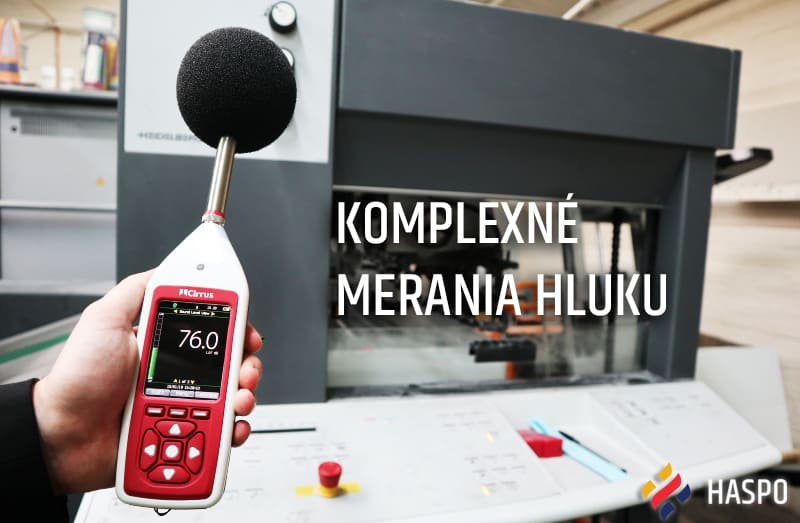
What we measure

Workplace noise

Noise measurement in the working environment as a basis for the health risk assessment and proposed noise-reduction measures.

Personal exposure

Measurement of employees' personal noise exposure during their actual work shift.

Environment

Environmental noise measurement, for example for businesses near residential buildings.

Noise studies

Noise studies with graphic output when you need to predict the noise of a new business or building.

Reports

A measurement report with measurement uncertainty; we calibrate the measuring chain before and after measurement.

Related services

Health risk assessment as part of the occupational health service and operating rules.

When you must measure noise

The employer must assess the level of noise to which employees are exposed and, if necessary, have it measured. If the action values can be expected to be exceeded, measurement must be carried out (Section 3 of Government Regulation No. 115/2006 Coll.). A new measurement is needed when the workplace changes, for example with a new machine or technology, and when there are doubts about the accuracy of the results.

The health risk assessment is repeated at least every 24 months for category 2 work and at least once a year for categories 3 and 4 (Section 30 of Act No. 355/2007 Coll.). The employer keeps records of the assessment and noise measurement for 20 years after the employee stops working with a noise risk.

Noise action and limit values

ValueLAEX,8hLCPkWhat the employer must do
Lower action value80 dB135 dBprovide hearing protection, inform and train employees, offer hearing tests
Upper action value85 dB137 dBtechnical and organisational measures, mark workplaces and restrict access, hearing protection is mandatory
Exposure limit value87 dB140 dBmust not be exceeded – reduce exposure immediately and find the cause

Under Annex 2 and Sections 4 to 6 of Government Regulation No. 115/2006 Coll. The attenuation of hearing protection is taken into account for the limit value but not for the action values.

Noise and work categorisation

CategoryNoise
Category 1LAEX,8h no more than 75 dB and LCPk no more than 130 dB
Category 2above 75 dB or above 130 dB, without exceeding the upper action value
Category 3upper action value exceeded, but LAEX,8h by less than 10 dB (LCPk by less than 3 dB)
Category 4exceeded by 10 dB or more (LCPk by 3 dB or more), or category 3 with established hearing damage

Under Annex 1 of Decree No. 448/2007 Coll. For category 2 to 4 work in terms of noise, operating rules must be drawn up (Section 12 of Government Regulation No. 115/2006 Coll.). From 15 July 2026 the health risk assessment with work categorisation is prepared in the electronic system of the public health authorities.

Noise by type of work – even in the office

Work groupExampleAction value LAEX,8h
Ioffice without noisy machines, meetings40 dB
IIordinary office work, computer work, laboratories50 dB
IIIsorting, packing, warehouse work, restaurant service65 dB
IVmainly physical work in production, construction, driving a motor vehicle80 dB

Under Table 1 of Annex 2 of Government Regulation No. 115/2006 Coll. Decree No. 549/2007 Coll. on environmental noise does not apply to workplaces.

Fines

Failure to provide a health risk assessment or missing operating rules can lead to a fine of €150 to €20,000. Failure to take technical, organisational and other measures against noise can lead to a fine of €2,000 to €50,000. Up to double for a repeat breach (Section 57 of Act No. 355/2007 Coll.).

How much noise measurement costs

tailored

The price depends on the number of measuring points, the number of shifts and job positions, the location and whether you also need a noise study. We will prepare a free, no-obligation quote promptly – just fill in the form.

Get a quote

Frequently asked questions about noise measurement

When is workplace noise measurement mandatory?

The employer must assess the level of noise to which employees are exposed and, if necessary, have it measured. If the action values can be expected to be exceeded, measurement must be carried out (Section 3 of Government Regulation No. 115/2006 Coll.).

What are the workplace noise limits?

The lower action value is 80 dB (LAEX,8h) and 135 dB (LCPk), the upper action value 85 dB and 137 dB, and the exposure limit value 87 dB and 140 dB. The attenuation of hearing protection is taken into account for the limit value but not for the action values (Annex 2 of Government Regulation No. 115/2006 Coll.).

How often must noise be measured?

The regulation does not set a fixed interval. A new measurement is needed when the workplace changes or when there are doubts about the accuracy of the results. The health risk assessment is repeated at least every 24 months for category 2 work and at least once a year for categories 3 and 4.

Who can carry out noise measurement?

The occupational health service or a person with a certificate of professional competence to determine physical factors in the working environment (Section 15 of Act No. 355/2007 Coll.). Accreditation is not required for measuring physical factors, which include noise. Our measurements are carried out by certified staff.

What noise level is permitted in an office?

Lower action values apply depending on the type of work: 40 dB for an office without noisy machines, meetings and negotiations, 50 dB for ordinary office work, computer work and laboratories (Table 1 of Annex 2 of Government Regulation No. 115/2006 Coll.).

What must the employer do if noise exceeds the values?

Above the lower action value, the employer provides hearing protection and informs employees. Above the upper action value, it must take technical and organisational measures, mark and restrict access to workplaces, and employees must use hearing protection. The limit value must not be exceeded.

How much does noise measurement cost?

We set a tailored price based on the number of measuring points, the number of work shifts and positions, the location and whether you also need a noise study. We will prepare a free, no-obligation quote promptly.

We measure noise and process the results

Measurement in the workplace and in the environment, a report, a noise study and a follow-up health risk assessment or operating rules.

Tailored quote

     We will prepare a quote promptly


        INFO LINE

    Michal

    Sales manager

    Phone
    +421 918 505 584

    Tailored quote

         We will prepare a quote promptly


      You get a 10% discount on each additional service you order.

          INFO LINE

      Michal

      Sales manager

      Phone
      +421 918 505 584

      4 branches · all of Slovakia

      Visit us

      We are close to you in Bratislava, Košice, Banská Bystrica and Vranov nad Topľou.

      Cenová ponuka ihneď